The building
The Dresden Zwinger: Its History
From Augustus the Strong's orangery of 1709 to the bombing of 1945 and the rebuilding: the history of the Zwinger and its Wallpavillon in brief.
Reserve a seat in the Wallpavillon ↗Quick answer
The Zwinger began in 1709, when Augustus the Strong commissioned the architect Matthäus Daniel Pöppelmann to build an orangery. It grew into a garden and a festival ground, was finished in 1728 and was closed on the river side by Gottfried Semper's gallery in 1855. The bombing of 1945 destroyed it, and rebuilding ran until 1963. The Wallpavillon, built between 1716 and 1719, is where the concerts are held.
An orangery for a king
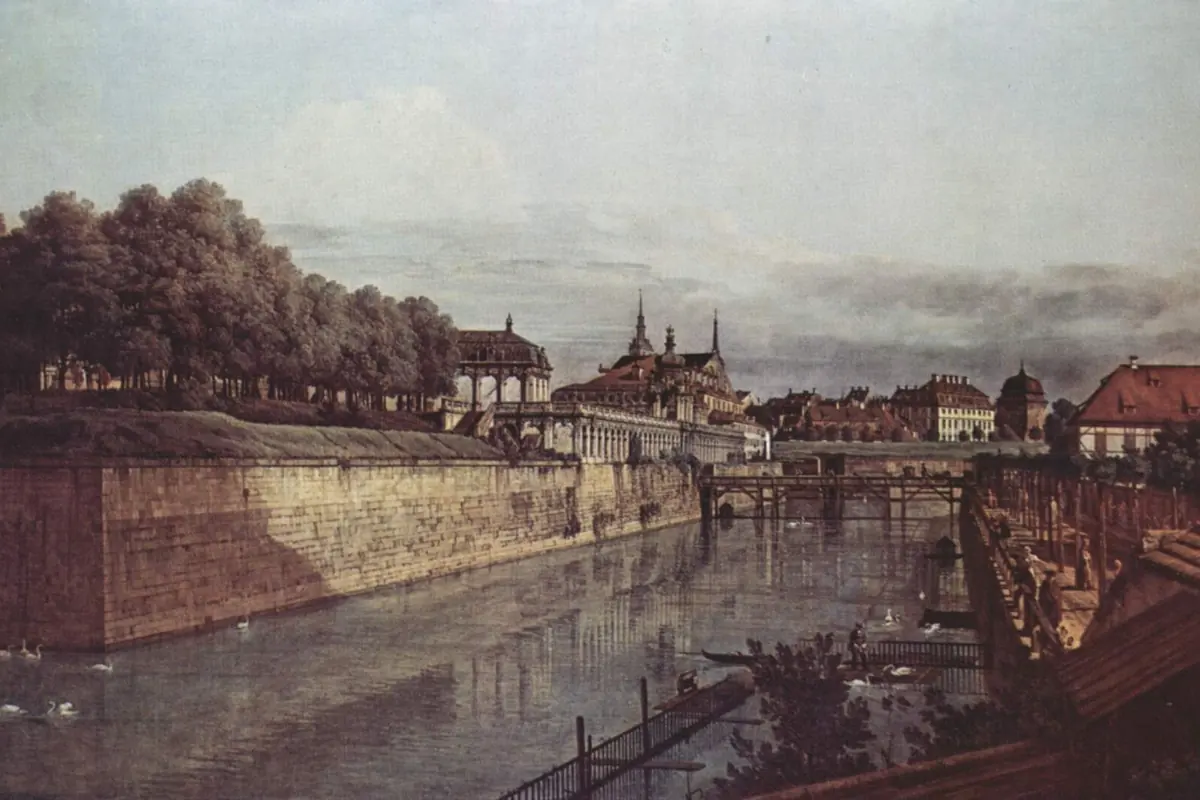
In 1709 Augustus the Strong, Elector of Saxony and elected King of Poland, commissioned Matthäus Daniel Pöppelmann to build an orangery for his collection of rare southern plants. The plan soon widened into a garden and a festival ground. Augustus had returned from a grand tour through France and Italy in 1687 to 1689, just as Louis XIV moved his court to Versailles, and he wanted something comparably spectacular for himself. The original plan, drawn before 1711, included gardens running down to the Elbe, where the Semperoper and its square were later built.
Why it is called the Zwinger
The name goes back to the medieval German word for the space between the outer and the inner wall of a fortress. The area between Dresden's two walls was used by the court for garden purposes. When work on the present Zwinger began in the early eighteenth century the walls no longer mattered, but the name was transferred to the new building. Some parts of the south-western buildings, including the Crown Gate, stand on the remains of the outer wall.
The Wallpavillon and the 1719 festival
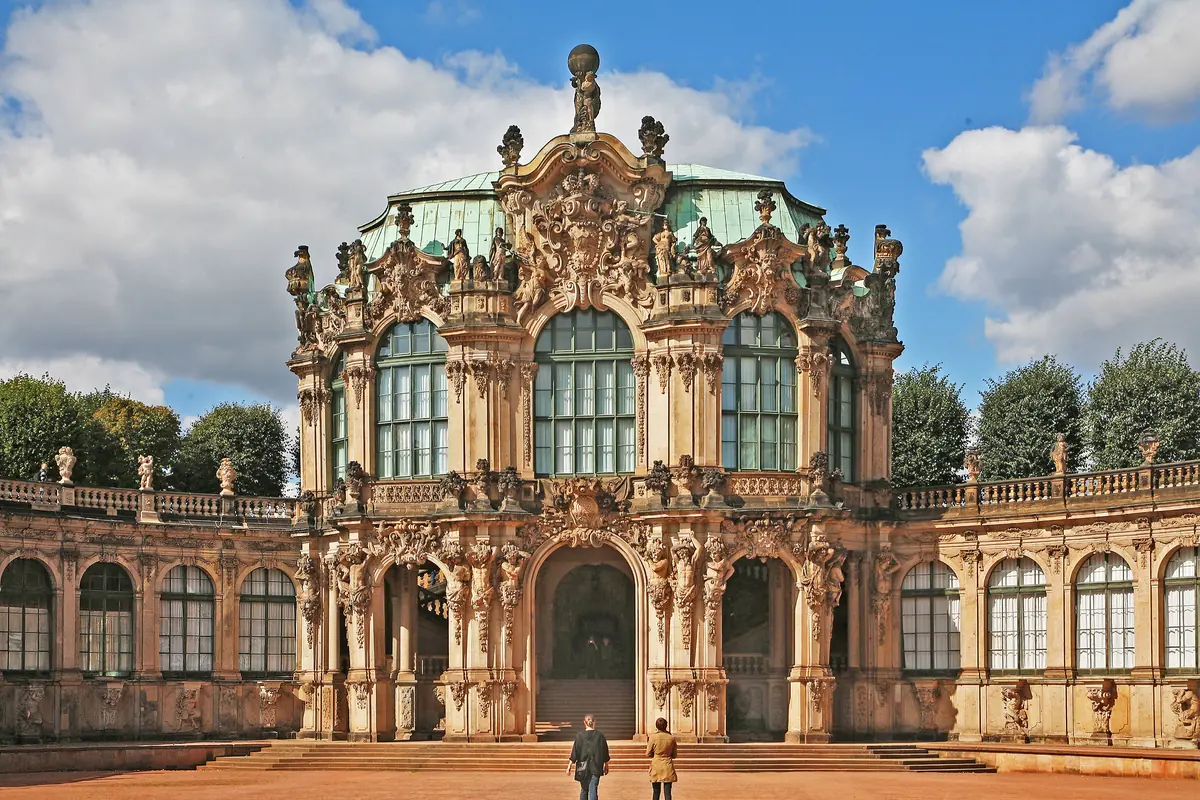
The state palace administration's timeline dates the building of the Wallpavillon to 1716 to 1719, after the arcades beside it were raised in 1710 to 1712. In 1719 the Zwinger was inaugurated with festivities for the wedding of the electoral prince Friedrich August II and the Archduchess Maria Josepha. Sculpture came from Balthasar Permoser, whose Hercules Saxonicus stands above the Saxon-Polish coat of arms on the pavilion.
The Crown Gate and the Nymphs' Bath
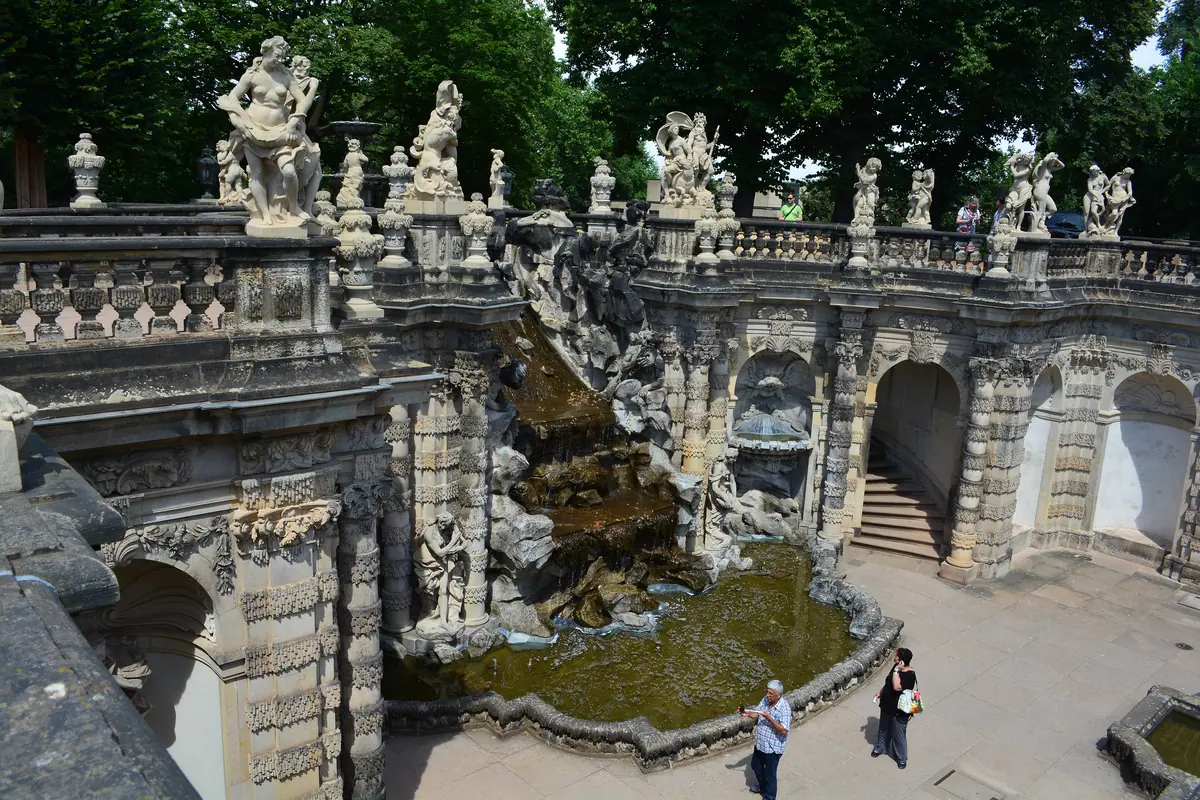
The Crown Gate, the Kronentor, was built between 1714 and 1718 together with the long galleries, with sculpture by Balthasar Permoser. It is shaped like the Polish crown, with four Polish eagles and figures of Hercules and Mars, a reminder that Augustus was also King of Poland. The Nymphs' Bath, begun in 1711, is the grotto with a cascade and sculptures that stands beside the pavilions.
Finished, then left open
The Zwinger buildings were completed in 1728 and housed collections and a library, and the most valuable Dresden collections have been kept there since. Augustus died in 1733, and the plan for a new castle between the Zwinger and the Elbe was dropped, so the courtyard stayed open on the river side. It took more than a century before Gottfried Semper's gallery building, built from 1847 to 1855, closed that side.
Wear and repair
The timeline lists damage in the Seven Years' War in 1759 and 1760, when the Prussian army used the Zwinger as a storage yard, and more in the Napoleonic wars from 1806 to 1813. Restorations followed from 1783 to 1795, 1857 to 1863 and 1880 to 1898, the last with cement and iron clamps that did harm. A thorough fourth restoration ran from 1924 to 1936, when the Zwingerbauhütte, the Zwinger's own building workshop, was founded under Hubert Ermisch.
Destruction and rebuilding
The bombing of Dresden on 13 and 14 February 1945 hit the Zwinger heavily, and the timeline records it as totally destroyed. The art collection had been evacuated beforehand. Reconstruction began in 1945 and ran to 1963 under Hubert Ermisch, Arthur Frenzel and Max Zimmermann. Parts reopened in 1951, the Crown Gate was finished in 1951 and the Wallpavillon opened to the public in 1963.
The Zwinger today
Since 1993 the Zwinger has been part of Schlösser und Gärten Dresden. It houses the Old Masters Picture Gallery, the Dresden Porcelain Collection and the Mathematisch-Physikalischer Salon. Its first purpose, as a festival ground, is still kept up with music and theatre events: the first Zwinger serenade in the courtyard took place on 3 July 1928, and the Wallpavillon now hosts the gala concerts this site is about. A general renovation began in 1985, the workshop was re-founded in 1991, and the reconstruction of the carillon in the Glockenspielpavillon was completed between 1993 and 1995.
Read next: Dresden Zwinger Concert: Booking
Frequently asked questions
Who built the Zwinger?
The architect Matthäus Daniel Pöppelmann designed it, with sculpture by Balthasar Permoser, for Augustus the Strong.
When was the Wallpavillon built?
Between 1716 and 1719, according to the palace administration's timeline.
Was the Zwinger destroyed in the war?
Yes. The bombing of February 1945 destroyed it, and reconstruction ran from 1945 to 1963.
Sources